2014年10月10日 星期五

Fire Limit State Design (FLS) for concrete structure

Fire Limit State Design (FLS) under Code of Practice for Structural Use of Concrete 2013


1. Definition:


cl. 1.4.1 & 2.2.3.1
Fire Limit State relating to the structural effects of a fire in a building or part of a building


2. Requirement for fire resistance

cl. 2.1.1
Adequate structural resistance for the required fire resistance period.

cl. 2.2.4.7
Durability and fire resistant

cl. 4.1.2
Appropriate degree of fire resistance
(a) flame penetration;
(b) heat transmission; and
(c) collapse.

cl. 4.3
Requirement for fire resistance
  1. Cover specified for durability will not be sufficient for fire protection in accordance with Code of Practice for Fire Safety in Buildings;
  2. Concrete compressive strength greater than 60 MPa, possible reduction of strength at elevated temperatures and the associated risk of spalling should be investigated, taken into account the relevant factors including moisture content, type of aggregate, permeability of concrete, possible heating rate and the silica fume content.

cl. 4.3.1 for high strength concrete
1. Prevention of spalling in high strength concrete
-          content of silica fume not exceed 6% by weight of total cementitious content
-          Pfa and ggbs comply with cl 4.2.5.5 for normal strength concrete

2. Method to reduce risk of concrete spalling. At least one of the following method
 (a) Method A: A reinforcement mesh with a nominal cover of 15mm. This mesh shall have wires with a diameter ≥ 2mm with a pitch ≤ 50 x 50mm. The nominal cover to the main reinforcement shall be ≥ 40mm;
(b) Method B: Include in the concrete mix not less than 1.5 kg/m3 of monofilament propylene fibres. The fibres shall be 6 – 12 mm long and 18 – 32 μm in diameter, and shall have a melting point less than 180°C;
(c) Method C: Protective layers for which it is demonstrated by local experience or fire testing that no spalling of concrete occurs under fire exposure; or
(d) Method D: A design concrete mix for which it has been demonstrated by local experience or fire testing that no spalling of concrete occurs under fire exposure.

3. For high strength concrete exceeding C80, at least one fire test should be carried out to demonstrate that the main reinforcing bars of a structural member shall not be exposed.


3. Design parameters:

cl. 2.2.3.2, 3.6, Table 3.5 to 3.7
Strength reduction factors
Elevated temperature
Reduction factors for concrete
Reduction factors for reinforcement
Reduction factors for tendon  using wires & stands
Reduction factors for tendon using bars
20 °C
1.00
1.00
1.00
1.00
100 °C
1.00
1.00
1.00
1.00
200 °C
0.95
1.00
0.82
1.00
300 °C
0.85
1.00
0.64
0.78
400 °C
0.75
0.87
0.44
0.55
500 °C
0.60
0.60
0.21
0.25
600 °C
0.45
0.36
0.09
0.09
700 °C
0.30
0.11
0.08
0.08
800 °C
0.15
0.08
0.06
0.06
900 °C
0.08
0.06
0.05
0.05
1000 °C
0.04
0.04
0.03
0.03
1100 °C
0.01
0.02
0.02
0.02
1200 °C
0.00
0.00
0.00
0.00

Elevated temperature see BS EN 1992-1-2

cl. 2.3.2.7 & Table 2.2
Partial safety factors for loads:
Loads
γf
Dead load
1.00
Imposed loads:
a) permanent:
1) those specifically allowed for in design, e.g. plant, machinery and fixed partitions
2) in storage buildings or areas used for storage in other
buildings (including libraries and designated filing areas)
b) non-permanent:
1) in escape stairs and lobbies
2) all other areas


1.00

1.00


1.00
*0.80
Wind loads
0.33
Note: *The value may be reduced to 0.50 when suitable justification is available


cl. 2.4.3.2 & Table 2.3
Partial safety factors for materials:
Material/design consideration
γm for ULS
γm for FLS
Reinforcement (prestressing steel included)
1.15
1.00
Concrete in flexure or axial load
1.50
1.10
Concrete shear strength without shear
Reinforcement
1.25
1.10
Bond strength
1.40
1.10
Others (e.g. bearing stress)
≥1.50
≥1.10

Effects of exceptional loads or localised damage. γm may betaken as 1.3 for concrete in flexure and 1.0 for steel.


Reference:
3. BS EN 1992-1-2 Eurocode 2 Design of concrete structures – Part 1-2 General rules:  Structural fire design


2014年9月22日 星期一

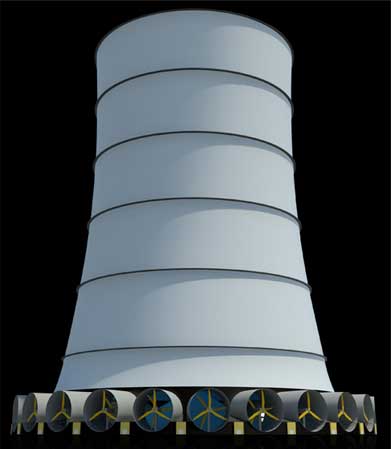
Solar Wind Tower Could Rival Hoover Dam

Solar Wind Tower Could Rival Hoover Dam 
solar-wind tower electric power generation
As the globe warms, the hottest places may be able to generate the most power through solar—particularly solar wind tower electric-power-generation plants, providing the hot places have water. At least hat's the premise put forward by supporters of this "concrete collossus," as some are calling it. This technology is one of many promising new ideas that point toward a solar-powered future, as we've suggested in our year-long Celestia Project, looking at innovation that's leading us toward a green "ecotopia" by the year 2100.

What is a Solar Wind Tower?
San Luis, Ariz., describes itself as the “gateway to the Sea of Cortez.” Located southwest of Yuma, between the Mexican border and the Colorado River, it will break ground on a solar wind tower power plant in 2015.


- See more at: http://www.greenbuildermedia.com/news/blog/news/solar-wind-tower-electric-power-generation#sthash.pxGFitdM.dpuf


2014年9月18日 星期四

Legislation and Publications Affecting the Building Industry (PNAP ADV-2)

Legislation and Publications Affecting the Building Industry (PNAP ADV-2)

A. Laws of Hong Kong 
Chapter
Relevant Ordinances
Website
123
 www.doj.gov.hk

123A
123B
123C
123F
123G

123H

123I
123J
123K
123L
123M
123N
123O
123P
7
17
28
40
51
53
59
95
102
121
124
126
128
130
131
132
152
172
172A
208
211
243
243A
276
279
279A
295
301
311
317
327
337
344
349
354
358
360
370
374
376
400
406
408
409
417
438
447
459
470
487
502
572
573
585

B. Technical Memorandum
Title
Department Website
www.bd.gov.hk

C. Codes of Practice Title
Title
Department Website
www.bd.gov.hk


Code of Practice for Hong Kong LPG Industry, Module1 – LPG Compounds and Cylinder Stores
Code of Practice for Hong Kong LPG Industry, Module2 – Underground LPG Pipework
Code of Practice for Hong Kong LPG Industry, Module3 – Handling and Transport of LPG in Bulk by Road
Code of Practice for Hong Kong LPG Industry, Module 7 – Operating Procedures for Emergencies for LPG Compounds and Cylinder Stores
Code of Practice for Hong Kong LPG Industry, Module 9 – LPG Cylinders

Fire Services Department www.hkfsd.gov.hk
Home Affairs Department www.had.gov.hk
Labour Department www.labour.gov.hk
* (Attention should be paid to “BS 7121-2: 2003 Code of Practice for Safe Use of Cranes. Inspection, Testing and Examination” as referred to by the Codes)
Transport Department www.td.gov.hk

 D. Design Manuals, Standards and Specifications
Title
Department Website
Buildings Department www.bd.gov.hk
www.cedd.gov.hk

Geoguide 1 : Guide to Retaining Wall Design
Geoguide 2 : Guide to Site Investigation
Geoguide 3 : Guide to Rock and Soil Descriptions
Geoguide 4 : Guide to Cavern Engineering
Geoguide 5 : Guide to Slope Maintenance
Geoguide 6 : Guide to Reinforced Fill Structure and Slope Design
Geoguide 7 : Guide to Soil Nail Design and Construction
Geospec 1 : Model Specification for Prestressed Ground anchors
Geospec 3 : Model Specification for Soil Testing
Highways Department www.hyd.gov.hk

E. Practice Notes
Title
Department Website

Buildings Department www.bd.gov.hk

 F. Guidelines
Title
Department Website


Buildings Department www.bd.gov.hk
Environmental Protection Department www.epd.gov.hk