2025年4月5日 星期六

Long lifetime Carbon-14 nuclear battery

According to the recent news by sciencenet.cn [1], it is known that the Northwest Normal University (西北師範大學)in China is exploring related technologies using the rare isotope carbon-14, especially in the development of nuclear batteries. 


燭龍一號 Zhulong No. 1

Development of Carbon-14 Nuclear Batteries
1. Technological Breakthrough: Northwest Normal University, in collaboration with Wuxi Beita Pharmatech, has successfully developed the country's first prototype of a carbon-14 nuclear battery, 'Zhulong No. 1'. This technology signifies a major advancement for China in the field of micro nuclear batteries.


2. Advantages of Carbon-14: Carbon-14 has a half-life of 5,730 years, capable of providing continuous and stable energy, making it particularly suitable for long-term power supply to micro-power devices. The beta radiation emitted has low energy, high safety, and does not release gamma rays, reducing protective difficulties.

3. Performance Characteristics: This nuclear battery is designed to operate stably in extreme environmental conditions ranging from -100°C to 200°C, with an ultra-high energy density 2200mWh/g and a performance degradation rate of less than 5% over its 50-year design life.

4. Application Prospects: The potential application range of carbon-14 nuclear batteries is wide, including medical devices (such as pacemakers), Internet of Things (IoT) devices, and extreme environmental detection (such as in the Antarctic, Moon, and Mars).


Theoretical review [6,7]
1. Nuclear batteries generate power by harnessing high-energy particles emitted by radioactive materials. Not all radioactive elements emit radiation that’s damaging to living organisms, and some radiation can be blocked by certain materials. For example,  β particles or  β rays can be shielded with a thin sheet of aluminum, making betavoltaics a potentially safe choice for nuclear batteries. 

2. Beta Battery Technology: Carbon-14 nuclear batteries are typically designed as beta batteries, which utilize β particles to impact semiconductor materials (such as titanium oxide TiO2) to generate current. When β particles interact with the semiconductor material, they create electron-hole pairs, which can then be collected and converted into electrical energy.

3. Energy Conversion Efficiency: Researchers are exploring methods to improve the energy conversion efficiency of carbon-14 nuclear batteries. For example, using dye-sensitized semiconductor materials can enhance the interaction between beta particles and the semiconductor, thereby improving the performance of the battery.


Reference:

2020年5月8日 星期五

Recent bridge incident

2020 - Bridge collapses in Italian town of Albiano Magra

The bridge had been built in 1908. It was one of the oldest reinforced concrete bridges in Italy.

2020 - 虎門大橋出現搖晃 (Humen Bridge, China) 


According to the engineer, the sudden wobbling could have been triggered by barricades, which changed the force of the wind on the bridge. "But this assumption can only be confirmed if the bridge remains stable when barricades are dismantled. If not, the builders and engineers should reconsider force structures of the bridge to avoid potential safety hazards."  Also, some experts said when the wind speed reaches about 8 m/s, it causes limited vortex vibration of the bridge. Humen Bridge is now under repair. The bridge deck added a 1.2 meters high retaining wall (water horse), thus destroying the section streamline caused by vortex vibration. At present, the retaining wall is being removed, according to media reports. (Global Times)

2019 - 312國道上海方向的北環路無錫一座行車大橋倒塌 (Wuxi, China)


The vehicles involved in the Wuxi incident, visible in photos after the incident and spotted by witnesses, were carrying large steel coils. One truck was carrying six hot-rolled steel coils that, according to the certificate affixed to one of the coils, weighed more than 6,000 pounds. If all of the coils were the same weight, the load would have been 171 tons – officially overweight. (Caixin)


2018 - 意大利北部港口城市熱那亞莫蘭迪大橋(Morandi Bridge)橋塔在暴雨中倒塌

43 people died in the collapse of the giant Morandi bridge in Genoa in August 2018.


The reason of the collapse of the Morandi bridge is currently hotly debated. Much hints to a lack of maintainance and a resulting failure of structural member. But also the heavy weather conditions with a Thunderstorm and a lighting impact are often blamed. (INACHUS)

2019 - 宜蘭南方澳大橋大崩塌 (Yilan, Taiwan)


東張西望 | 台灣跨港大橋倒榻 直擊斷橋瞬間


2015年4月15日 星期三

Building Maintenance Cost (BMC) Database and Estimator

HKU Department of Real Estate & Construction launches online platform on Building Maintenance Cost (BMC) Database and Estimator

A dedicated interactive online platform, including a Building Maintenance Cost (BMC) Estimator, at http://bmc.versitech.hku.hk/http://bmc.versitech.hku.hk/, has been established to disseminate the findings of this pilot project.

he powerpoint presentation at the conference, please click.

2015年3月13日 星期五

Queen's University Belfast to create world's largest flat-pack bridge

Queen's University Belfast to create world's largest flat-pack bridge
January 26, 2015


The arch is one of the greatest engineering achievements of human history. Perfected over 2,000 years ago by the Romans, there are examples in bridges and buildings all over Europe that date back almost as long. However, stone arches aren't easy to build. They need skilled masons, special forms made out of wood or steel, and a lot of patience. Even modern arch bridges made out of poured or pre-stressed concrete require a lot of time and labor to construct.

"This innovative system is exceptional as it is easily transported in flat pack form and then rapidly installed on site," says Macrete project manager, Abhey Gupta. "It is also unique as its strength does not depend on corrodible reinforcement, thus it should have a lifetime of at least 300 years whereas conventional bridges seldom achieve their design life of 120 years."


Reference:

1. Macrete precast concrete engineers
2. FlexiArch: from conceptto practical applications - The Structural Engineer July 2004
2. Gizmay

2014年10月10日 星期五

Fire Limit State Design (FLS) for concrete structure

Fire Limit State Design (FLS) under Code of Practice for Structural Use of Concrete 2013


1. Definition:


cl. 1.4.1 & 2.2.3.1
Fire Limit State relating to the structural effects of a fire in a building or part of a building


2. Requirement for fire resistance

cl. 2.1.1
Adequate structural resistance for the required fire resistance period.

cl. 2.2.4.7
Durability and fire resistant

cl. 4.1.2
Appropriate degree of fire resistance
(a) flame penetration;
(b) heat transmission; and
(c) collapse.

cl. 4.3
Requirement for fire resistance
  1. Cover specified for durability will not be sufficient for fire protection in accordance with Code of Practice for Fire Safety in Buildings;
  2. Concrete compressive strength greater than 60 MPa, possible reduction of strength at elevated temperatures and the associated risk of spalling should be investigated, taken into account the relevant factors including moisture content, type of aggregate, permeability of concrete, possible heating rate and the silica fume content.

cl. 4.3.1 for high strength concrete
1. Prevention of spalling in high strength concrete
-          content of silica fume not exceed 6% by weight of total cementitious content
-          Pfa and ggbs comply with cl 4.2.5.5 for normal strength concrete

2. Method to reduce risk of concrete spalling. At least one of the following method
 (a) Method A: A reinforcement mesh with a nominal cover of 15mm. This mesh shall have wires with a diameter ≥ 2mm with a pitch ≤ 50 x 50mm. The nominal cover to the main reinforcement shall be ≥ 40mm;
(b) Method B: Include in the concrete mix not less than 1.5 kg/m3 of monofilament propylene fibres. The fibres shall be 6 – 12 mm long and 18 – 32 μm in diameter, and shall have a melting point less than 180°C;
(c) Method C: Protective layers for which it is demonstrated by local experience or fire testing that no spalling of concrete occurs under fire exposure; or
(d) Method D: A design concrete mix for which it has been demonstrated by local experience or fire testing that no spalling of concrete occurs under fire exposure.

3. For high strength concrete exceeding C80, at least one fire test should be carried out to demonstrate that the main reinforcing bars of a structural member shall not be exposed.


3. Design parameters:

cl. 2.2.3.2, 3.6, Table 3.5 to 3.7
Strength reduction factors
Elevated temperature
Reduction factors for concrete
Reduction factors for reinforcement
Reduction factors for tendon  using wires & stands
Reduction factors for tendon using bars
20 °C
1.00
1.00
1.00
1.00
100 °C
1.00
1.00
1.00
1.00
200 °C
0.95
1.00
0.82
1.00
300 °C
0.85
1.00
0.64
0.78
400 °C
0.75
0.87
0.44
0.55
500 °C
0.60
0.60
0.21
0.25
600 °C
0.45
0.36
0.09
0.09
700 °C
0.30
0.11
0.08
0.08
800 °C
0.15
0.08
0.06
0.06
900 °C
0.08
0.06
0.05
0.05
1000 °C
0.04
0.04
0.03
0.03
1100 °C
0.01
0.02
0.02
0.02
1200 °C
0.00
0.00
0.00
0.00

Elevated temperature see BS EN 1992-1-2

cl. 2.3.2.7 & Table 2.2
Partial safety factors for loads:
Loads
γf
Dead load
1.00
Imposed loads:
a) permanent:
1) those specifically allowed for in design, e.g. plant, machinery and fixed partitions
2) in storage buildings or areas used for storage in other
buildings (including libraries and designated filing areas)
b) non-permanent:
1) in escape stairs and lobbies
2) all other areas


1.00

1.00


1.00
*0.80
Wind loads
0.33
Note: *The value may be reduced to 0.50 when suitable justification is available


cl. 2.4.3.2 & Table 2.3
Partial safety factors for materials:
Material/design consideration
γm for ULS
γm for FLS
Reinforcement (prestressing steel included)
1.15
1.00
Concrete in flexure or axial load
1.50
1.10
Concrete shear strength without shear
Reinforcement
1.25
1.10
Bond strength
1.40
1.10
Others (e.g. bearing stress)
≥1.50
≥1.10

Effects of exceptional loads or localised damage. γm may betaken as 1.3 for concrete in flexure and 1.0 for steel.


Reference:
3. BS EN 1992-1-2 Eurocode 2 Design of concrete structures – Part 1-2 General rules:  Structural fire design


2014年9月22日 星期一

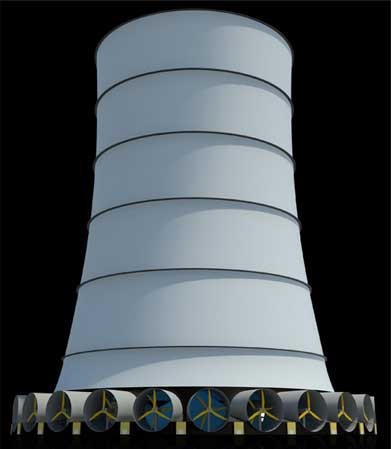
Solar Wind Tower Could Rival Hoover Dam

Solar Wind Tower Could Rival Hoover Dam 
solar-wind tower electric power generation
As the globe warms, the hottest places may be able to generate the most power through solar—particularly solar wind tower electric-power-generation plants, providing the hot places have water. At least hat's the premise put forward by supporters of this "concrete collossus," as some are calling it. This technology is one of many promising new ideas that point toward a solar-powered future, as we've suggested in our year-long Celestia Project, looking at innovation that's leading us toward a green "ecotopia" by the year 2100.

What is a Solar Wind Tower?
San Luis, Ariz., describes itself as the “gateway to the Sea of Cortez.” Located southwest of Yuma, between the Mexican border and the Colorado River, it will break ground on a solar wind tower power plant in 2015.


- See more at: http://www.greenbuildermedia.com/news/blog/news/solar-wind-tower-electric-power-generation#sthash.pxGFitdM.dpuf


2014年9月18日 星期四

Legislation and Publications Affecting the Building Industry (PNAP ADV-2)

Legislation and Publications Affecting the Building Industry (PNAP ADV-2)

A. Laws of Hong Kong 
Chapter
Relevant Ordinances
Website
123
 www.doj.gov.hk

123A
123B
123C
123F
123G

123H

123I
123J
123K
123L
123M
123N
123O
123P
7
17
28
40
51
53
59
95
102
121
124
126
128
130
131
132
152
172
172A
208
211
243
243A
276
279
279A
295
301
311
317
327
337
344
349
354
358
360
370
374
376
400
406
408
409
417
438
447
459
470
487
502
572
573
585

B. Technical Memorandum
Title
Department Website
www.bd.gov.hk

C. Codes of Practice Title
Title
Department Website
www.bd.gov.hk


Code of Practice for Hong Kong LPG Industry, Module1 – LPG Compounds and Cylinder Stores
Code of Practice for Hong Kong LPG Industry, Module2 – Underground LPG Pipework
Code of Practice for Hong Kong LPG Industry, Module3 – Handling and Transport of LPG in Bulk by Road
Code of Practice for Hong Kong LPG Industry, Module 7 – Operating Procedures for Emergencies for LPG Compounds and Cylinder Stores
Code of Practice for Hong Kong LPG Industry, Module 9 – LPG Cylinders

Fire Services Department www.hkfsd.gov.hk
Home Affairs Department www.had.gov.hk
Labour Department www.labour.gov.hk
* (Attention should be paid to “BS 7121-2: 2003 Code of Practice for Safe Use of Cranes. Inspection, Testing and Examination” as referred to by the Codes)
Transport Department www.td.gov.hk

 D. Design Manuals, Standards and Specifications
Title
Department Website
Buildings Department www.bd.gov.hk
www.cedd.gov.hk

Geoguide 1 : Guide to Retaining Wall Design
Geoguide 2 : Guide to Site Investigation
Geoguide 3 : Guide to Rock and Soil Descriptions
Geoguide 4 : Guide to Cavern Engineering
Geoguide 5 : Guide to Slope Maintenance
Geoguide 6 : Guide to Reinforced Fill Structure and Slope Design
Geoguide 7 : Guide to Soil Nail Design and Construction
Geospec 1 : Model Specification for Prestressed Ground anchors
Geospec 3 : Model Specification for Soil Testing
Highways Department www.hyd.gov.hk

E. Practice Notes
Title
Department Website

Buildings Department www.bd.gov.hk

 F. Guidelines
Title
Department Website


Buildings Department www.bd.gov.hk
Environmental Protection Department www.epd.gov.hk